Be a RICH and HAPPY Landlord
How to deal with difficult tenants?
How to evict a bad tenant?
Join "SwhengTee Landlorlding talk" at KLCC Convention Centre on 15th Nov 2009.

Be a RICH and HAPPY Landlord!!
For reservation, contact us at 03-7983 0103 or email to swhengtee@yahoo.com
Tourism-Related & Green Building Properties on the Rise

After the recently concluded Budget Talk, there was special emphasis on tourism-related properties as well as the introduction of the Green Building Index. The government is on the right track in focusing their efforts on areas like the tourism sector. During a time where the slowdown of the manufacturing & export industry is visible, the Budget 2010 does show the determination to develop the economy though tourism, where majority of foreign countries receive popular and ‘hot’ reviews. In comparison, the Malaysian tourism is indeed in an infant stage.
According to Gavin Tee, a Real Estate Investment Consultant, the Green Building Index will lead the way in all future developments. “The emphasis will be on environmental friendly energy savings, recycling of resources, and cost reduction for maintenance. Thus, the government’s proposal for a tax & stamp duty exemption is an indicator of their determination in moving towards this new direction.”
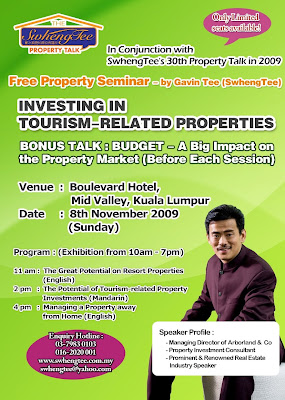
In conjunction with Gavin’s 30th Property Talk in 2009, he will be offering a Free property talk on the 8th November (Sunday) in Boulevard Hotel, Mid Valley. Individuals who are eager to gain the insights on the budget updates on GBI, RPGT, and the Potential tourism-related properties should not miss this opportunity.
The 1 hour talks will be scheduled at 11am, and 4pm (2pm in Mandarin) along with an exhibition from 10am to 7pm. Those interested are welcome to join.
Green Buildings and Tourism-related Properties rising to demand
The next hot investment topic and new trend in real estate development will change course to Tourism-related properties and environmental friendly Green Buildings. Gavin Tee will be sharing the above at level 8, Boulevard Hotel, Mid Valley City on Sunday ( Nov 8 ) from 10am to 7pm.
Reintroducing RPGT - A Losing Game
A Losing Game
In times of a fragile economy, the government should adopt a strategy on stimulating the activities of the real estate market, giving much needed incentives rather than imposing taxes.Gavin Tee, a real estate investment consultant and speaker commented, “The market was just beginning to show signs of recovery and that is a positive note for market stabilization. However, we have yet to see the influx of foreign investments and gain the full confidence from property home buyers. Thus, it is not a good time to reintroduce Real Property Gains Tax.”
“The key issue should not be on the support to big developers, mega projects and multi corporations but on building the basics – the market condition. The basic economic theory to rescue the market should be applied, which is; to create a market and not to create a product. Thus, imposing RPGT is actually against the way.”
Gavin believes that the imposing of Real Property Gains Tax would affect a loss of income for the government in stamp duty collections. “The high deductions would greatly impact the number of Sales & Purchase transactions. It will further affect the business in the construction and professional services industry. In overall, there will be lesser stamp duty and taxes received by the government.”
“For example, a property with a value of RM 1mil will yield RM 24,000 as stamp duty payments. Assuming that it can be sold at RM1.2mil and make a RM200,000 profit, a sum of RM 10,000 will be collected as Real Property Gains Tax. With this introduction, the government may not only lose the RPGT revenue but potentially also the stamp duty fees due to the worsening of the market caused by RPGT.”
“Furthermore, Real Property Gains Tax would reduce Real Estate market price, further decreasing the stamp duty collection and ultimately affecting the government income.”
The introduction of RPGT would greatly affect 2 sectors, which is the high end real estate as well as the secondary property markets, particularly to older homes. “Whatever efforts in place now to strengthen the property market will go to waste,” he said.
“Real Property Gains Tax should only be applied when the property market overheats and absolutely not during a cool market period. This move will not only heavily impact the construction, renovation, raw materials and the professional services industry but also directly affecting the people’s and government’s income.”
In conclusion, Gavin hopes the government will reconsider its proposal for Real Property Gains Tax.
Reinstatement of RPGT Act 1976 ?
Last Friday Prime Minister Dato Seri Najib proposed that a tax of 5% be imposed on gains from the disposal of real property effective from Jan 1st 2010 during the Budget 2010 proposal. However, Gavin Tee, a Property Investment Consultant and Speaker interpreted otherwise. “From the official web site of MOF, 5% as a fixed rate imposed on the gains is misunderstood.”
Also as the Managing Director of real estate agency Arborland & Co, Gavin pointed out that according to the finance bill, the government proposed to reintroduce the RPGT ACT 1976, in which the taxes shall be as high as 30% if the property is being disposed in the first two years.
The proposal is to add on 5% on the sixth year onwards which was exempted by the act before it was abolished. The new tax scheme applied to the individual will be the same applied to corporate ownership, which is higher than the original.
However, the Finance Ministry reassured the governmen proposed a fixed rate of 5% imposed on gain instead of reintroducing the RPGT Act 1976. He said it is expected to come up with an exemption order on the Real Property Gains Tax (RPGT) this week to clear the confusion surrounding the RPGT proposal.
The Real Property Gain Tax Act was gazetted in 1976, under the Act, in order to curb speculation; gains on disposal of property are subject to RPGT. The tax are scheduled as high as 30% on the 1st and 2nd years of disposal, 20% on the 3rd year, 15% on the 4th year and 5% on the fifth year. It shall be exempted if the property is disposed on the sixth year onwards. The Act was abolished in April 1st, 2007. ( But it was not really abolished but exempted)
Gavin commented, “The Real Estate Market is only in its initial stage of recovery, and the proposal will definitely create a big impact to the High-end property market, particularly to the areas of newly completed projects and those that are in oversupply. If the Act is reintroduced, I believe it will stop the foreign investment and worsen the real estate market.”
Gavin Seriously recommends the Government to reconsider the proposal.
It is unfair for the OLD HOUSE OWNERS to pay RPGT
Pay Real Property Gain Tax disregar of tenure of ownership
Now , you may need to pay for Real Property Gain Tax disregarding how long you have owned the property, unless you are able to dispose it before Jan 1st , 2010.According to the proposal of Budget 2010, the government will impose 5% tax on gains on disposal of real property despite of the tenure of ownership. Real Estate Investment Consultant Gavin Tee feels it is very unfair to the genuine property owners who have owned a property for many years and who also never have any intention on speculation.
The reason of introducing Real Property Gain Tax Act 1976 was to curb speculation, especially on short term investment. Thus a 30% of tax was imposed on the disposal during the first and second year. 20% on the 3rd year, 15% on the forth year and 5% on the fifth year. Tax will be exempted on the sixth year onwards for the individual investors but remain 5% for the corporate owner. As a result, most of the property investors only dispose their properties after 5 years of ownership. This Act slowed down the investment activities to the property industry.
Besides, if the government impose a fixed 5% tax disregards on the tenure of ownership, a house owner who purchased a house 20 or 30 years ago in Klang Valley will have to pay a “hefty” Gain Tax next year onwards for the disposal.
Gavin quotes an example, a link house purchased 20 or 30 years ago may only cost RM50,000 , and if the owner disposing it now at RM750,000, he therefore will be liable for RM35,000 of Tax. Furthermore, a property owner may never expect this abolished act can be reintroduced with amendment that a gains tax across board without allowance of any holding period. Thus, they may not keep any receipt on renovation or home improvement for tax deduction purpose.
Thus, Gavin recommends the proposal shall only apply to the property acquire on Jan 1st , 2010 or later .
Furthermore, a bungalow in Kuala Lumpur may only valued at RM200,000 years back but now maybe sold at RM 4 million and above. The proprietor thus have to incur more than RM200,000 of property gains tax next year. Whereas under the old act 1976 , if an individual house owner disposes the property after 5 years, there is no tax charged. This proposal will definitely create a big impact on the secondary market, particularly to the properties acquired at an early days and very unfair to property owners who acquired for own stay.
Budget 2010
The public has been heavily speculating on the upcoming Budget Talks, as concerns were focused on whether the government would adopt an aggressive approach to sustain and save the Malaysian economy after the downturn. According to Gavin Tee, a Real Estate Investment Consultant & Managing Director of Arborland & Co (Real Estate Agency), the general public should not be expect too much and neither too many surprises in the government policy compared with recent years.
“I believe that a surprising and aggressive stance by the government would not come around this time. This is because the government has already injected mini budget allocations for the past year.”
“However, one positive view is that this would be our new Prime Minister Dato Seri Najib’s first involvement in the financial budget. I believe in his determination to reform the nation’s economic condition,” he added.
He explained that the new PM is very well versed in the trends of globalization and cross border investments.
“Dato Seri Najib is well aware that these transactions are crucial and must be his first priority. Hence, he will be eager to make policy changes to meet the world standards.”
According to Gavin, the government’s focus may be on several areas. “The key area should be on the construction sectors involved in infrastructure and real estate development. However, I hope to see such mega projects develop according to the main economic principles and ensure the effectiveness of the project. In the past, failures do occur because of favoritism.”
He also commented that the property sector could be a boost towards the economy. “If you look at geographic statistics, Asia’s economic growth is led by the property and real estate market, especially China and Singapore.
I believe that the Malaysian Real Estate market can easily be the leader for recovery as our market has yet to be aggressively involved in the cross border and international property ring.” He also added that the Malaysian property price is still one of the lowest in the region, hence there is a great potential for the sector to grow.
When asked for suggestions in reviving the economy, Gavin said “We should look into the government assets, whereby there are ‘white elephants’ or abandoned projects and under utilized government buildings. The government could increase income by privatizing or leasing such properties by offering the incentive to the private sectors in the budget. These sectors would then have the initiative to contribute in offsetting the deficit.”
“The government should not impose higher taxes, but to increase their spending and create an active economy in order to generate more revenue. For example, there were remarks on resuming Real Property Gains Tax (RPGT). Gavin thinks the government should not reintroduce it as it will heavily slow down the property transactions and affect the stamp duty revenue. The loss of stamp duty could be higher than the collection of RPGT. Furthermore, imposing RPGT will have a negative impact to the real estate market. The decrease in property prices will seriously yet again lower down the collection of stamp duty.”
In addition, Gavin proposed to waive the stamp duty for properties valued at RM300,000 and below, particularly in the city centre as a medium-low cost property in the city costs around that amount.
“Lastly, we should promote the tourism sector or more specifically into the tourism related properties. Malaysia is rich with resources to promote and attract international players. The government must emphasize on promoting this sector by developing resorts, tourism and hospitality related properties. This will lead ultimately to less dependence on the exports and manufacturing industries, which are more competitive in the world market.”
“We hope the government would indeed stress a key emphasis and inject a much needed stimulus to these proposed areas.”

8:49 AM
水兴浪 Gavin Tee
, Posted in